
B Corp companies in Japan and their engagement in policymaking
12/1 2025
Author: Mari Kosaka
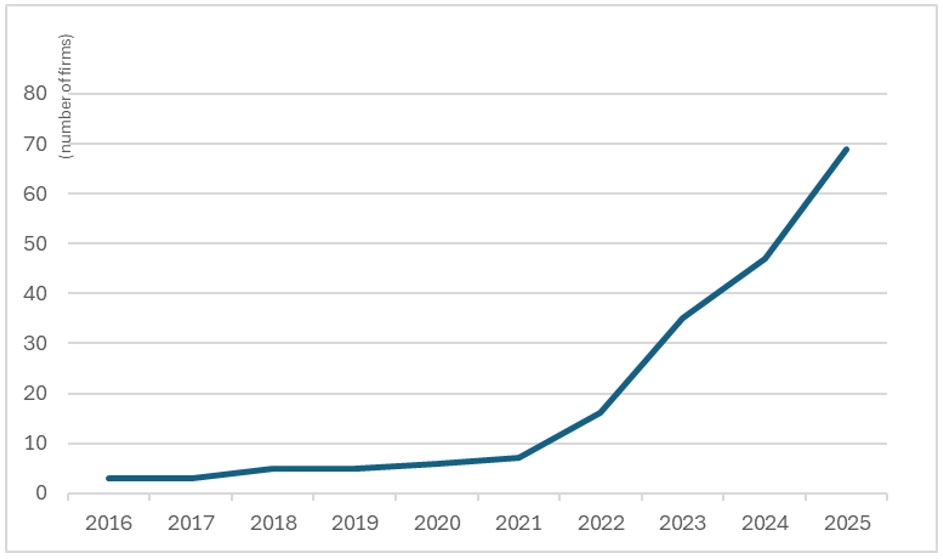
One prominent certification awarded to companies demonstrating high levels of performance in social and environmental dimensions is the B Corp certification, administered by B Lab, a U.S.-based non-governmental organization. In Japan, the first domestic company obtained B Corp certification in 2016, and for several years thereafter the number of certified firms remained limited. In recent years, however, the situation has changed markedly. As of the end of December 2025, the number of certified companies in Japan has reached 69, with particularly rapid growth observed since 2022 (Figure 1). Although this figure remains small compared to those in Europe and North America, it suggests that interest in demonstrating corporate social responsibility and sustainable management through formal certification has been growing rapidly in Japan.
From a policy perspective, what makes the B Corp certification particularly noteworthy is that its assessment standards explicitly include activities such as lobbying, engagement with public policy, and rule-setting at the industry level. Under the new standards to be introduced in 2026, these activities will be positioned more clearly as part of “collective action” and will be given greater weight. This design reflects an understanding of small and medium-sized enterprises—which constitute the majority of B Corp-certified companies—not merely as economic actors, but as policy actors capable of contributing to the resolution of public issues and to policymaking processes.
Against this backdrop, it is worth examining how Japanese B Corp-certified companies are responding to these expectations regarding policy engagement. Some illustrative cases can be identified. For example, Seafood Legacy has established corporate policies that explicitly include policy advocacy for stronger labor protections and human rights in the fisheries sector. Similarly, Kuradashi, a company engaged in reducing food loss, has entered into a business collaboration agreement with Osaka Prefecture aimed at reducing food loss and promoting regional revitalization.
At the same time, however, these examples remain limited. When viewed at the national level in Japan, it is difficult to conclude that companies systematically disclose information on their engagement in policies directly linked to the realization of a sustainable society, or on related lobbying activities. For many Japanese firms, policy engagement thus appears to remain an area of corporate activity that is not easily made visible.