The Spread of Doctor Helicopters in Japan
2/15 2026
Author: Osami Sagisaka
The practice of transporting doctors by helicopter to emergency scenes for on-site treatment is known as HEMS (Helicopter Emergency Medical Service) or Air Ambulance. In Japan, it is called “Doctor-Heli””. These helicopters carry medical equipment and pharmaceuticals necessary for initial treatment and stand by at base hospitals or similar locations, ready for dispatch. The use of helicopters allows for significantly faster arrival at the scene and earlier initiation of treatment compared to ambulances. Research indicates that patients transported by “Doctor-Heli” experience a 30% reduction in mortality compared to ambulance transport, with a 40% or greater increase in successful societal reintegration.
“Doctor-Heli” are believed to have originated in 1952 with mountain rescue operations in Switzerland. Subsequently, they spread to countries like Germany for handling traffic accidents and similar emergencies. Japan's introduction of “Doctor-Heli” followed somewhat later, beginning in 2001. During the Great Hanshin-Awaji Earthquake of 1995, helicopters were scarcely used for saving victims. Only one injured person was transported by helicopter on the day of the disaster. This led to widespread opinion advocating greater use of helicopters for emergency rescue, prompting national consideration.
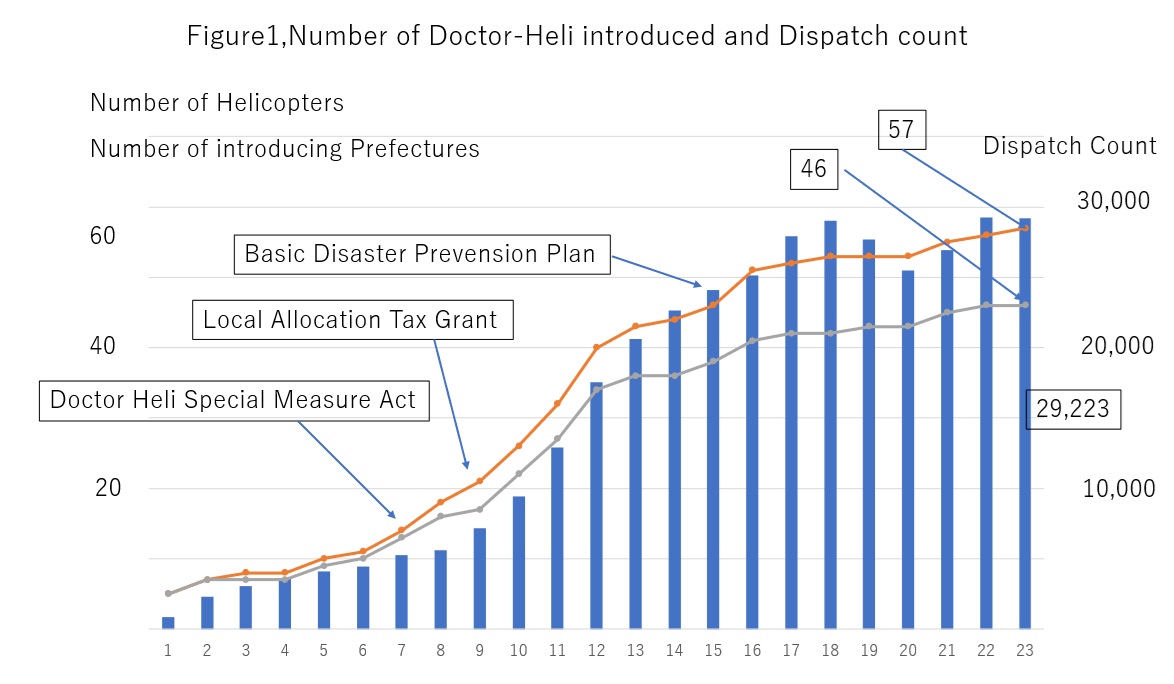
While each prefecture is the primary operator of “Doctor-Heli” program, the actual helicopter operations are contracted out to private companies. Relying solely on national subsidies was insufficient, and initially, the program did not gain widespread adoption. Consequently, various strategies were considered. One key step was recognizing the need for legislation to clearly establish the necessity of “Doctor-Heli” at the national level. This became a political issue, including the formation of a cross-party parliamentary league in the Diet. In 2007, the Doctor Helicopter Promotion Special Measures Act was enacted through a private member's bill. Bolstered by this legislation, “Doctor-Heli” was included as an eligible expense under the Local Allocation Tax system, compensating for the shortfall in national subsidies and providing funds to prefectures. This occurred in 2009. Around the same time, the TV drama “Code Blue: Doctor-Heli Emergency Rescue” aired. Its high ratings, partly due to the cast's popularity, significantly contributed to raising public awareness of “Doctor-Heli”.
Thus, the spread of “Doctor-Heli” advanced significantly (fig1). With the start of operations for Kagawa Prefecture's “Doctor-Heli” in April 2022, they were deployed in all prefectures (Kyoto Prefecture is covered by the Kansai Regional Federation). Currently, 57”Doctor-Heli” operate from 67 hospitals, responding to approximately 27,000 calls annually and treating around 22,000 injured or ill patients.
“Doctor-Heli” are expected to play a vital role not only at emergency scenes but also during large-scale disasters. During the 2011 Great East Japan Earthquake, 18 helicopters from across the nation were mobilized. At that time, the command structure and operational guidelines for “Doctor-Heli” during such mobilizations were unclear. Consequently, Ministry of Health, Labour and Welfare issued guidelines for their operational framework during large-scale disasters. Furthermore, to enhance disaster response capabilities, their role is now incorporated into the Basic Disaster Management Plan. During the 2024 Noto Earthquake disaster, 5”Doctor-Heli”, primarily from the Chubu region, were mobilized and transported 84 disaster victims.
Furthermore, it has become indispensable for securing regional medical systems. In Japan, where population decline continues, rural areas are experiencing significant population loss, making it difficult to maintain hospitals and other medical institutions. For residents in such areas, the means of transporting patients to distant hospitals has become critically important. “Doctor-Heli” also play a vital role in providing highly specialized medical care, such as pediatric medicine. In Aichi Prefecture, specialized doctors from the Pediatric Medical Center are transported via “Doctor-Heli” to the patients requiring their expertise.