
Artificial Intelligence Applications in Desert Research
1/15 2026
Authors: Troy Sternberg, Chris McCarthy
Deserts present physical, climate, spatial and analytical challenges for researchers. Technological progress, from computing power and earth observation to machine learning and human-like data analysis, has expanded possibilities. Now the power of Artificial Intelligence (AI) unlocks vast capacity for investigation and evaluation of the arid world. As academics our challenge is to integrate AI into our research paradigms to advance knowledge and improve and understanding. Applying AI tools can overcome limitations of traditional research methods. Here we use AI to assess wildlife populations dispersed across vast territories in the Gobi Desert of Mongolia.
Wildlife Detection and Conservation
Species monitoring in desert environments faces unique challenges due to great expanse, low population, limited accessibility and research costs. Today AI-powered image analysis from drones and satellites enables efficient wildlife identification and surveys across extensive desert landscapes. The task of locating, enumerating and assessing wildlife populations has been transformed by AI tools. Our recent study demonstrates the potential for monitoring various desert species including ungulates, carnivores, and birds. Machine learning models, particularly deep learning architectures like YOLO and R-CNN, can process aerial imagery to detect and count animals with increasing accuracy. These systems learn to distinguish animals from complex desert backgrounds, addressing the challenge of camouflage and terrain variability.
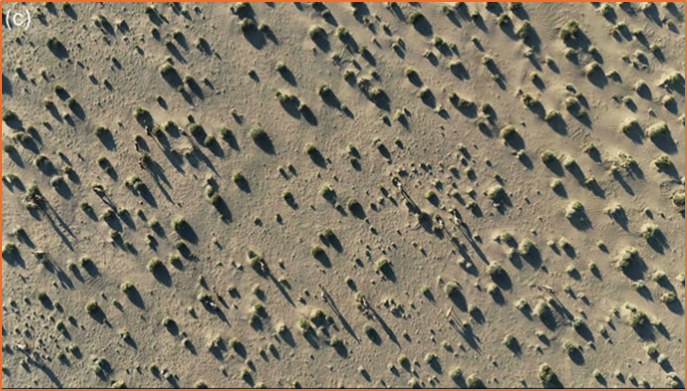
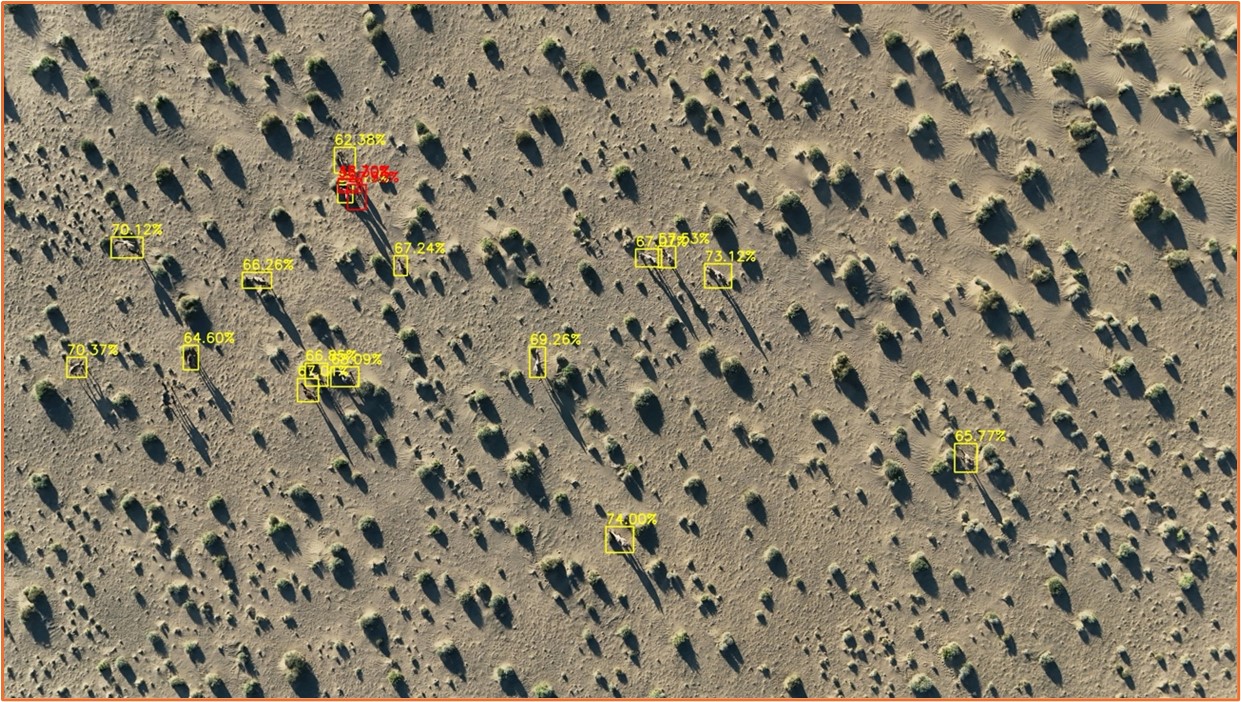
In our research in Mongolia's Gobi Desert, YOLOv8 achieved over 90% accuracy in detecting Bactrian camels from drone imagery. (McCarthy et al., 2025) (Figure 1 a, b). Across landscapes the model provided consistent processing and high precision in wildlife detection. Once trained to identify camels the model processed 63,000 images per hour, far beyond human capacity. For an endangered desert species, the enhanced monitoring provides early warning of population changes. Findings significantly advance conservation monitoring for camels and wildlife in remote ecosystems, tracking population dynamics and shaping conservation strategies in challenging habitats.
In desert research, AI machine learning, numerical processing and analytical power expand conventional assessment capabilities. Technical proficiency and time efficiency are remarkable, increasing investigative scope. AI offers powerful tools for synthesizing existing desert research and identifying knowledge gaps as studies are often scattered across disciplines and geographical regions. Methodologies, such as deep & machine learning and neural networks, offer scalable approaches for research assessment across global landscapes. As conditions and technologies continue to evolve, research is essential to understand and manage the world's arid environments. Our research identifies how the new AI research paradigm can make positive contributions in data-rich arid and semi-arid investigations. AI also presents challenges and caveats, with potential negative consequences. The integration of Artificial Intelligence into desert research represents not just a technological advancement but a fundamental shift in our capacity to study and protect these vital ecosystems.
References
McCarthy, C., Phillips, S., Sternberg, T., Yadamsuren, A., Nasanbat, B., Shaney, K., Hoshino, B., Enkhjargal, E., 2025, forthcoming. Can artificial intelligence support Bactrian camel conservation? Testing machine learning on aerial imagery in Mongolia’s Gobi Desert. Envir. Conserv. 1–8.